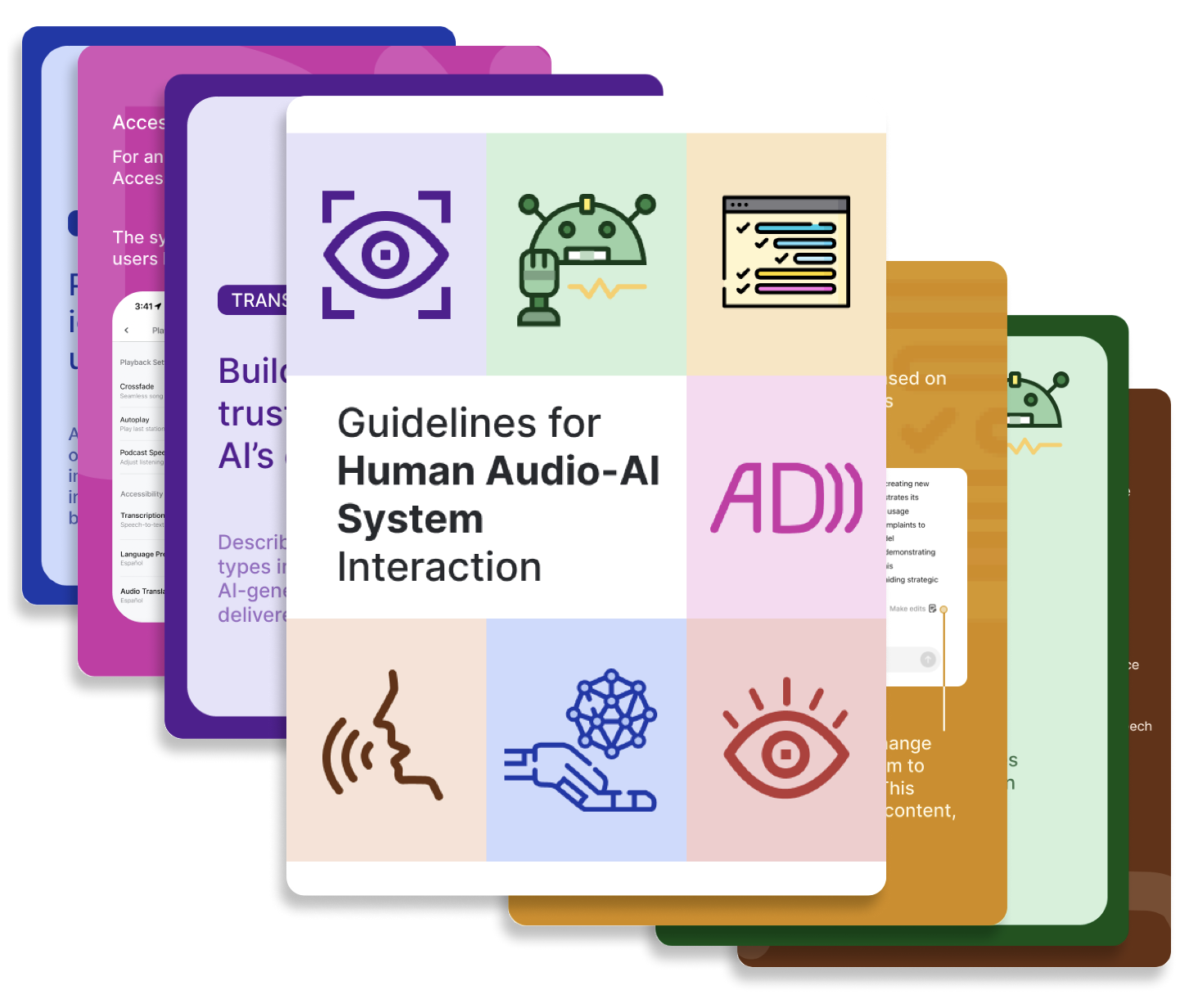
Reimagining Radio in the Age of Generative AI
UX Researcher (1 of 2) | Mixed Methods, AI Strategy & Responsible AI
TL;DR: Reframed iHeart’s GenAI exploration from “feature experimentation” to bounded integration grounded in listener trust and passive listening contexts. Co-led multi-phase research and developed what our landscape review identified as the first Responsible AI guidelines designed specifically for audio experiences, translating emerging risks into product guardrails that created a credible path for responsible public experimentation.
RELEVANCE OF THIS WORK TO PRESENT DAY
As GenAI moves from experimentation to integration, the core question is no longer what AI can do, but under what conditions it should operate.
This project addressed that question in audio, where trust is fragile and attention is often limited. At the time of our 2023–2024 landscape review, established resources offered cross-domain guidance for human-AI interaction and AI risk management, but we found no publicly available framework tailored to audio-specific risks such as voice likeness, parasocial attachment, passive listening, and synthetic-host disclosure.
Instead of asking “What AI feature should we build?” we reframed the decision space:
? Where can GenAI add value without eroding the “human host” moat?
? How do we innovate without destabilizing relational trust?
? What guardrails are required if GenAI goes public in audio?
? How do we compete in AI without reactive mimicry?
This reframing prevented solution-first design and anchored the work in risk-informed innovation.
THE DECISION GAP

My role: As one of two UX Researchers working alongside two Designers, I helped define the conditions under which AI could responsibly exist in this ecosystem before experimentation scaled.
My contributions focused on:
Co-architected the multi-phase research strategy.
Designed the exploratory survey.
Lead cross-method synthesis across survey, interviews, and workshop to translate findings into strategic decisions
Authored the Responsible Audio-AI framework.
RESEARCH CONSTRAINTS
This work needed to operate within real organizational constraints:

Audio AI can hallucinate, mislead, or feel “too human” without consent.
Trust Risk

Most users listen while commute or driving (76% reported using live radio; majority commute-based listening).
Low-Attention Context

Uneven AI Readiness
Familiarity with AI-supported audio dropped below 50% (vs high familiarity with AI in general).

Repeatable Governance
We needed mitigations that could scale beyond a one-off prototype.
My co-researcher and I built a funnel from broad → narrow → build to avoid novelty-driven exploration:
Secondary Research to map current AI-audio use cases and known concerns like misinformation, loss of “human essence,” ownership.
1.

RESEARCH STRATEGY (CO-LED)
Throughout the study, participants represented varied listening habits, commute contexts, and levels of familiarity with AI-supported audio.
Exploratory Survey (N=100) to establish listener baseline and AI perceptions.
2.
Exposure-Testing Interviews (N=6) to identify where acceptance increased and where it collapsed by testing reactions to AI news, AI podcasts, voice likeness, and AI DJ formats.
3.
Co-Design Workshops (N=6) to generate and pressure-test community-based experiences, ethical boundaries, and governance expectations.
4.
Concept & Usability Testing (N=6) to iterate on voice modes, customization controls, and accessibility considerations.
5.
iHeart wanted to explore AI-integrated audio content. But In late 2023, when generative AI began rapidly entering consumer media, “AI in radio” was uniquely risky:
Voice is intimate and human-coded.
Consumption is often passive (e.g., commuting/driving).
Credibility failures are expensive in a trust-based medium.
No radio-specific Responsible AI principles existed.
Meanwhile, competitors were already launching AI DJs and automated radio experiences, and risks of using AI like misinformation, bias, and loss of “human essence” were being uncovered.
This wasn’t feature exploration. It was high-stakes innovation under uncertainty.
THE CORE PROBLEM
KEY INFLECTION: CONDITIONAL OPENNESS (LED SYNTHESIS)
Across the survey and interviews, a consistent pattern emerged:
Users were not resistant to AI.
They were conditionally open.
AI that supplemented rather than replaced human content (news/weather, translations, customization).
What worked

Context-aware personalization when transparently signaled.
Preservation of human connection.
What did not work

Unlabeled AI hosts.
Likeness recreation without consent.
Hallucination risk.
Misuse by bad actors.
Privacy ambiguity.
This revealed that acceptance of AI in audio was not binary. Acceptance depended on whether AI augmented human connection or attempted to replace it. These patterns directly informed the strategic decisions that shaped the product direction.
KEY JUDGMENT CALLS
We prioritized augmentation over AI-host replacement.
Tradeoff: Less novelty in exchange for stronger brand fit and adoption potential.
1. Supplement, Don’t Replace
2. Anchor in Community-Led Personalization
Rather than a grab bag of AI utilities, we converged on community channels, preserving ritual and connection while using AI for scalable facilitation.
Tradeoff: One strong directional bet rather than multiple shallow experiments.
3. Responsible AI for Audio-AI Systems (Led end-to-end)
Our impact assessment identified risks involving misinformation, algorithmic discrimination, harmful community content, voice and likeness misuse, and personal data. Existing Responsible AI frameworks addressed many of these concerns broadly, but our landscape review did not identify guidance specifically for audio-AI.
I helped translate our research and risk assessment into seven Responsible Audio-AI guidelines, which were then mapped to concrete design and system decisions.
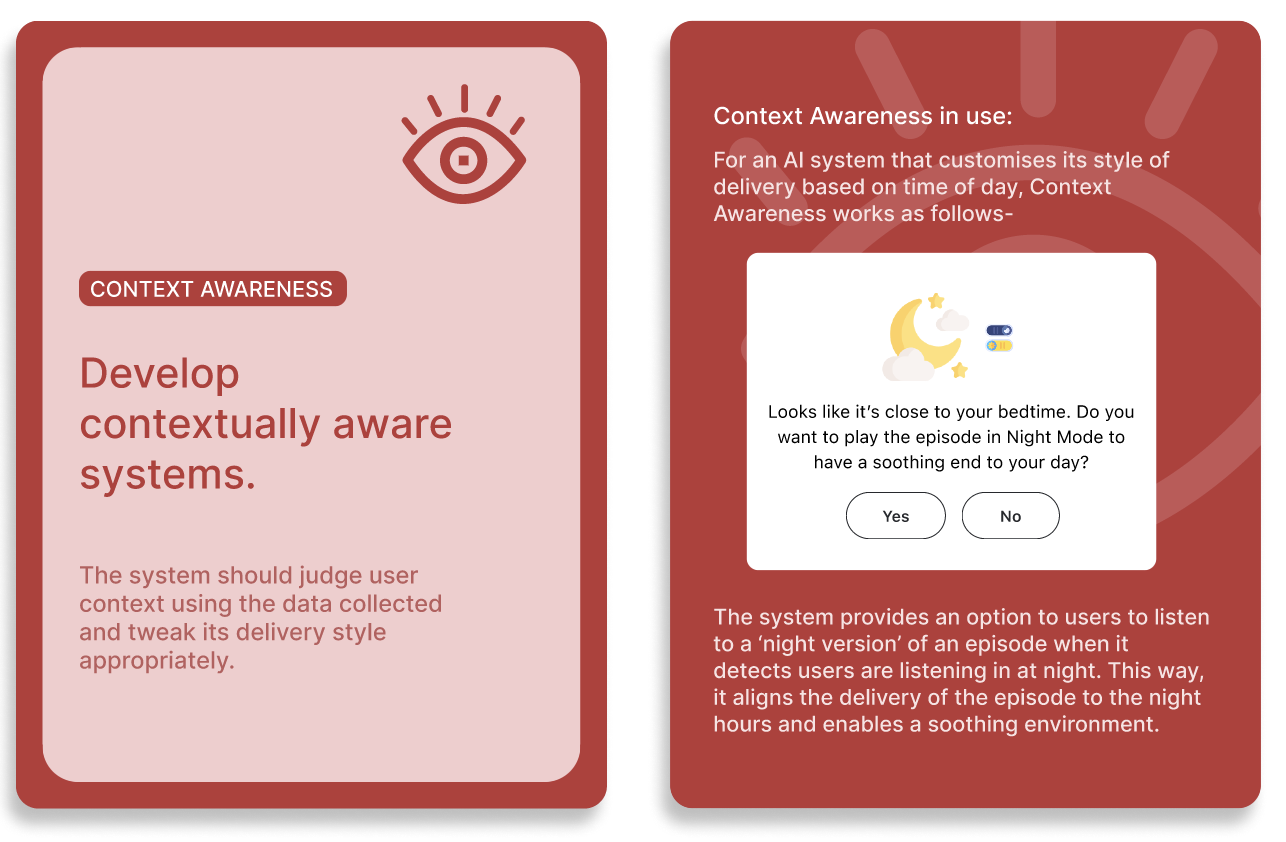
Tradeoff: Time invested in governance reduced prototype polish but created a credible path to ship.
We proposed using AI as community infrastructure that delivers personalized community-driven radio stations. The concept included:
THE PROPOSED DIRECTION

Shared-interest group channels in community-driven personalized stations.

Clear role hierarchy.

Public or private communities.

Explicit AI transparency and control signals.

Scalable across community types and sizes.

User-controlled customization boundaries.
This repositioned GenAI from synthetic performer to connective scaffolding. Strategically, this reduced reputational risk while preserving competitive differentiation.

Defined the strategic conditions for GenAI in radio, grounding innovation in real listening behavior and shaping AI-driven community radio experiences.
IMPACT
Demonstrated engagement potential among non-users under 35, with documented expressed intent to use the proposed experience beyond the study.
Identified public-facing AI risks and translated them into proposed guardrails for transparency, role hierarchy, and data control.
Established what our landscape review identified as the first Responsible AI guidelines designed specifically for audio experiences, embedding governance into product development and guiding future audio-AI initiatives.
GenAI in audio changes trust dynamics because audio feels human and is consumed passively. A viable strategy must couple innovation with actionable governance. This project demonstrated that competitive AI strategy in high-trust ecosystems requires structural constraint.
WHY THIS MATTERS
WHAT I’LL CARRY FORWARD
Here are some key takeaways from this study that taught me more about research-
AI strategy is constraint strategy. The strongest work is often deciding what not to automate.

In GenAI, safety is UX. Approvals, labeling, and controls are interaction design, not policy. Governance and experience design must co-evolve.
Responsible AI must be operationalized. Principles only influence products when teams can connect them to concrete interfaces, permissions, workflows, and system behaviors.