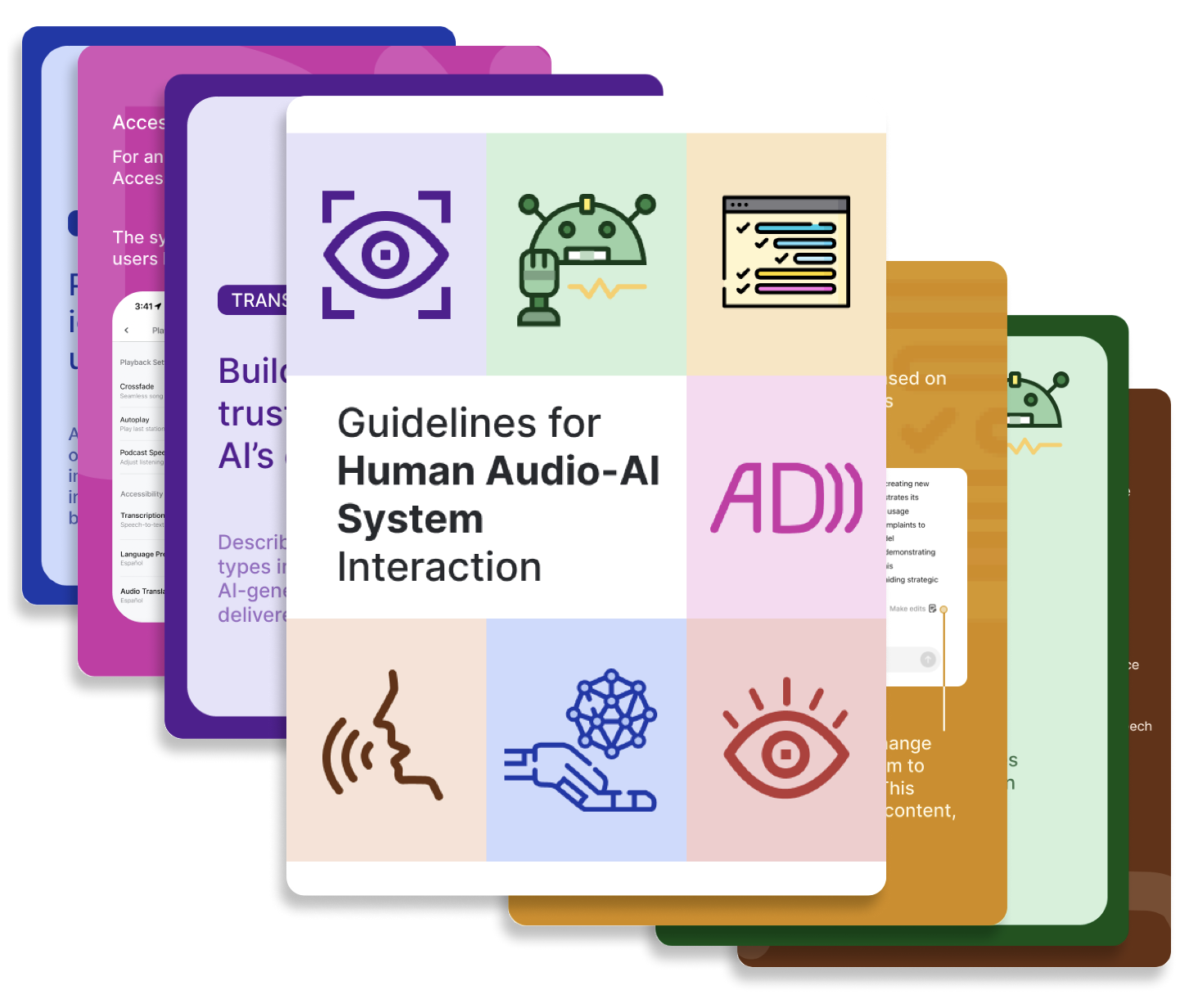
Turning Responsible-AI into Audio-Innovation Practice
Lead UX Researcher | Mixed Methods, AI Strategy & Responsible AI
TL;DR: I led the development of seven Responsible Audio-AI guidelines by combining listener research, established AI standards, and an AI impact assessment. The framework translated risks involving synthetic voices, content provenance, personal data, and human oversight into concrete product requirements.
My role: I led the framework generation in a team of 2 researchers and 2 designers. I synthesized evidence, scoped the work, facilitated critique with senior researchers, and connected the loop to product application. Finally, I worked with a designer to produce design cards.
BUILDING THE FRAMEWORK
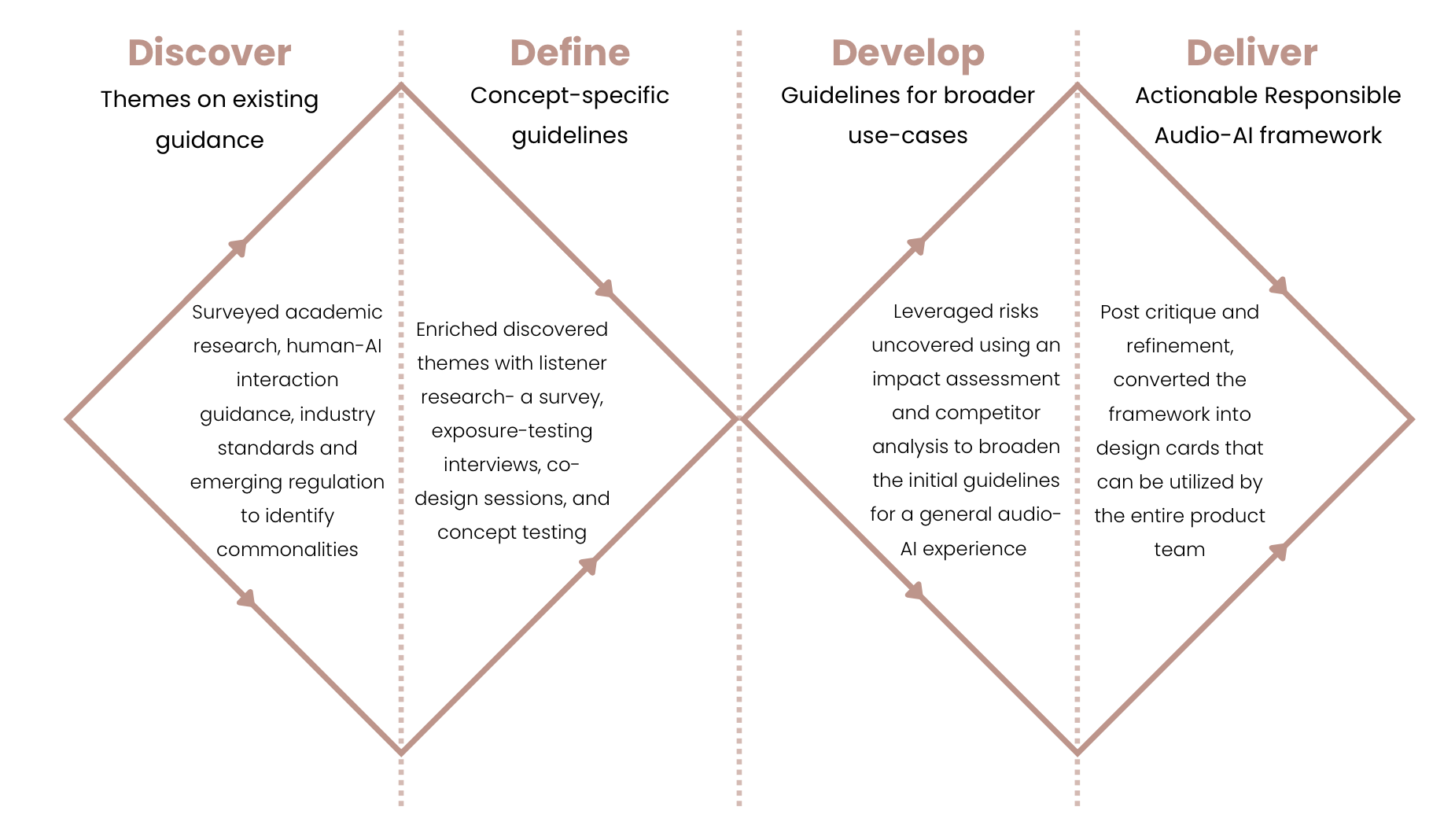
The broader work I did for iHeartRadio to conceptualize AI as a part of their services* informed the guidelines. My process resembled a double-diamond approach-
As my team helped iHeartRadio navigate AI-integrated audio content in the risky market of late 2023, the core question of under what conditions should GenAI operate in audio consistently remained unanswered. While existing Responsible AI frameworks addressed general AI concerns, our 2024 landscape review did not identify publicly available guidance tailored to the social and perceptual characteristics of AI-generated audio.
THE CORE PROBLEM
THE RISKS UNDER CONSIDERATIONS
Once I had used our primary research to form the first iteration of guidelines, I wanted to ensure this work could be used for a wider set of audio-AI use cases. So, I conducted an impact assessment of how our proposed experience could affect various user categories, along with competitor analysis of the few audio-AI services that existed in the market in 2023. This surfaced six primary risks-

This prompted me to ask what protections must exist before the AI acts, and not just question what it should do.

A recognizable voice recreated without authorization
Voice Misuse

An AI host presenting hallucinated information as credible
Misinformation

Community content can introduce scams/misinformation
Harmful Submissions

Personalization using data without clear boundaries
Privacy Intrusion
Curation can disadvantage certain communities or artists

Algorithmic Discrimination
Listeners cannot distinguish human from AI-generated content
Ambiguous AI Identity
All gathered evidence came together to define product needs that fed into the framework. The set of guidelines was reviewed with senior researchers for structured critique. The review examined whether:
Each guideline addressed a distinct decision area
The language could apply beyond our concept
Product professionals could connect it to a product requirement
The framework balanced user protection with meaningful AI functionality
I used the feedback to make the guidelines more actionable, ensuring each guideline passed a practical test: if it could not inform a behavior, control, workflow, or requirement, it needed further refinement.
REFINING THE FRAMEWORK
THE RESPONSIBLE AUDIO-AI GUIDELINES
The final Responsible Audio-AI guidelines were presented as design cards to promote actionable inclusion during decision making.
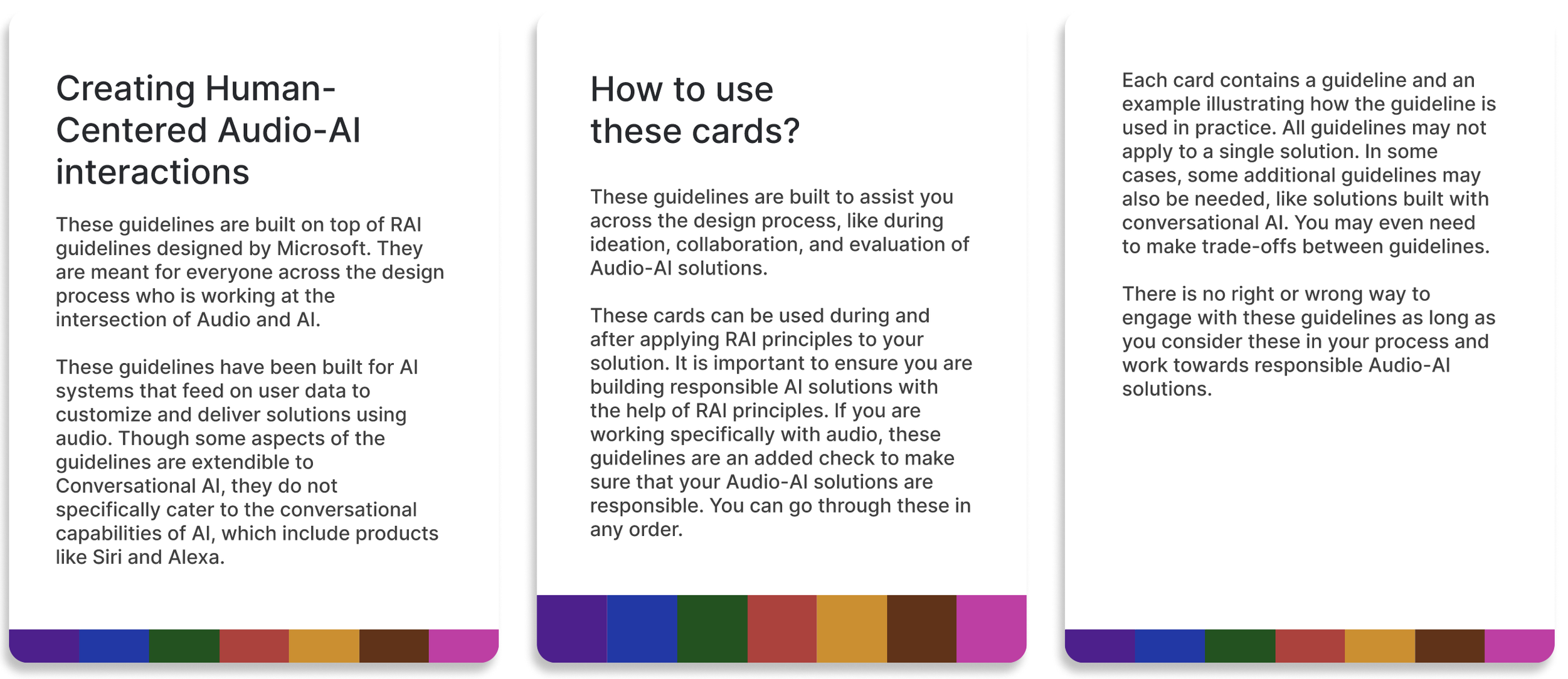
The set of cards with seven guidelines opened with instructions on how to use them, drawing inspiration from Microsoft’s RAI cards.
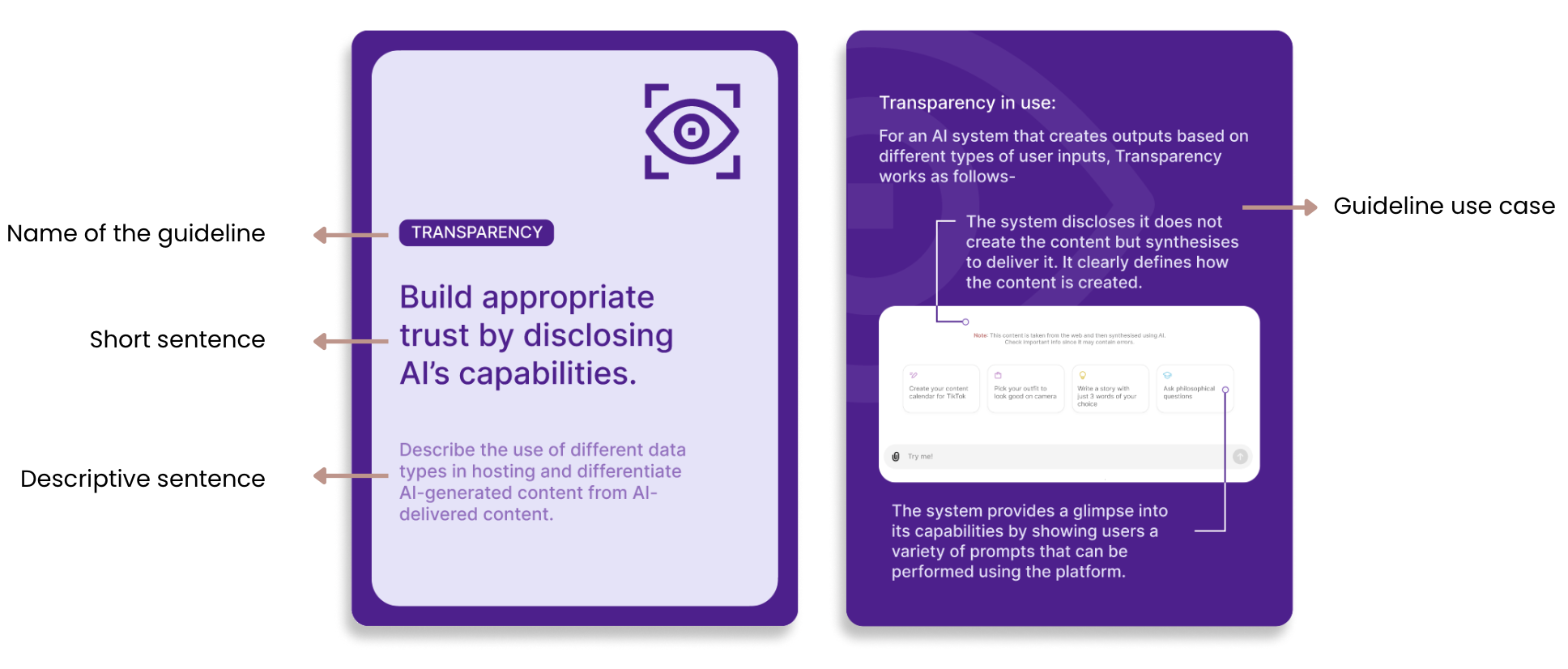
The front of the card named the guideline for easy identification. It also contained a short sentence about the guideline followed by another descriptive sentence to clarify exact context. This resembled the writing style recommended by Microsoft. The back side of the card cited an example where the guidelines was in use to help initiate ideation. If an existing use case did not exist, my designer teammate and I ideated a realistic application of the guideline.
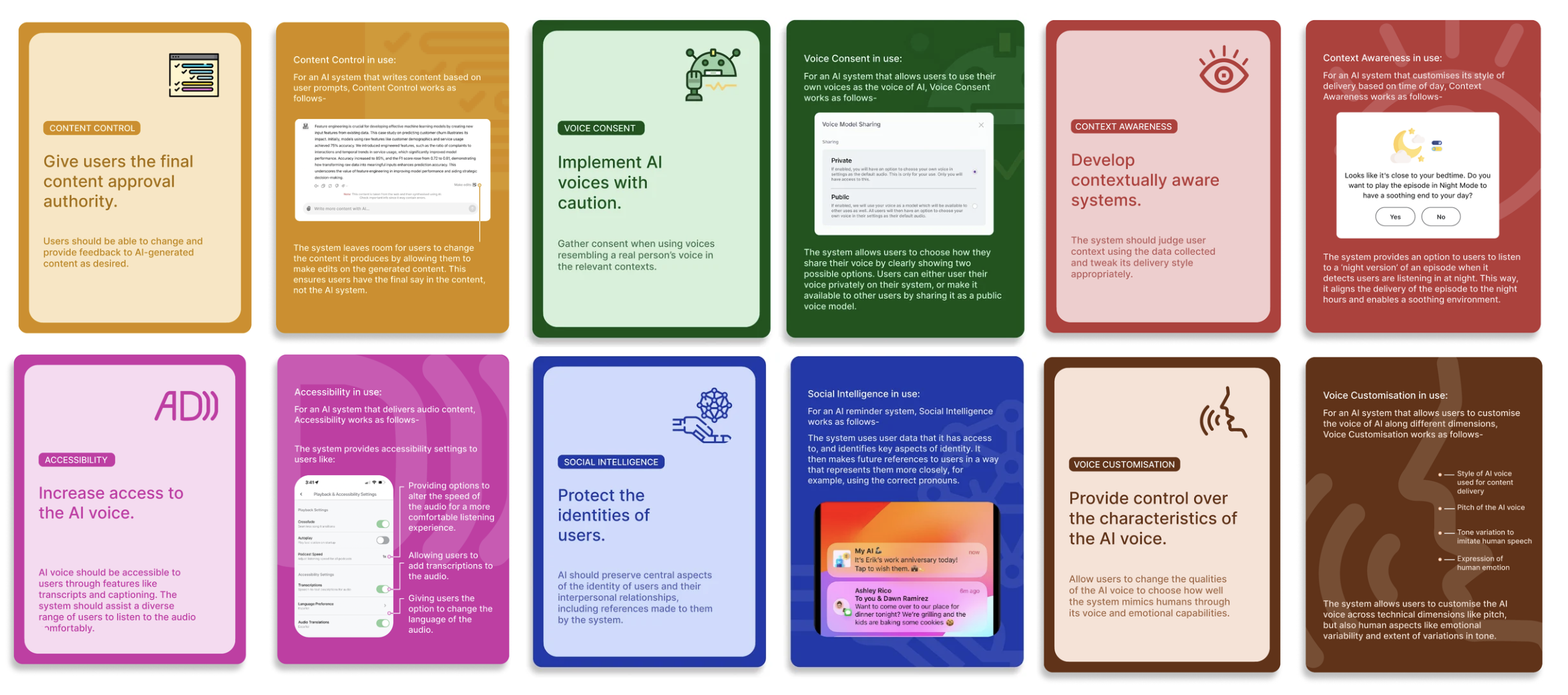

Embedded transparency, consent, accessibility, data boundaries, and human oversight as an intentional part of experience design.
IMPACT
Connected Responsible AI risks to specific product requirements.
Provided iHeartRadio with an audio-specific AI foundation for responsibly evaluating future experiences.
Brought governance into concept development rather than treating it as a final compliance review.
The framework was applied to an exploratory concept whose usefulness was assessed through expert critique and its ability to produce concrete product requirements. Given promising results, toward design teams and in turn the impact on customers, guidelines like these effectively operationalize product exploration in volatile tech environments.
In an innovation landscape like today’s, this work should be extended to product, engineering, legal, accessibility, policy, and content-moderation teams. Research initiatives should assess longitudinal adoption, harm-reduction metrics, and impact on product decisions.
WHY THIS MATTERS
WHAT I’LL CARRY FORWARD
Here are some key takeaways from this study that taught me more about research-
Guidance becomes actionable when it is domain specific, reflects the medium, behavioral context, and ways a system can affect identity, relationships, and trust.

Safety mechanisms like labeling, consent, approvals, permissions, and personalization controls are UX decisions.
If a guideline cannot inform a requirement, workflow, control, or system behavior, it is not yet useful to a product team.